What Protuno Costs: Plans, Credits And Free Runs
The audits and monitoring cost nothing. Playbook runs and agent work cost credits. The whole picture.
Two things are billed: a subscription per connected site, and credits consumed when an agent does work. Watching a site is neither.
What never costs credits
- The audits. 54 checks from the domain alone, and 85 once a site is connected. Neither costs credits.
- Monitoring. Watching a site is unmetered on every plan.
- Two playbooks per site, weekly. WP Security Audit and Cron Health Checker.
What costs credits
- Playbook runs. Charged per step, itemised.
- Fix With Super Agents and agent conversations, charged as tokens.
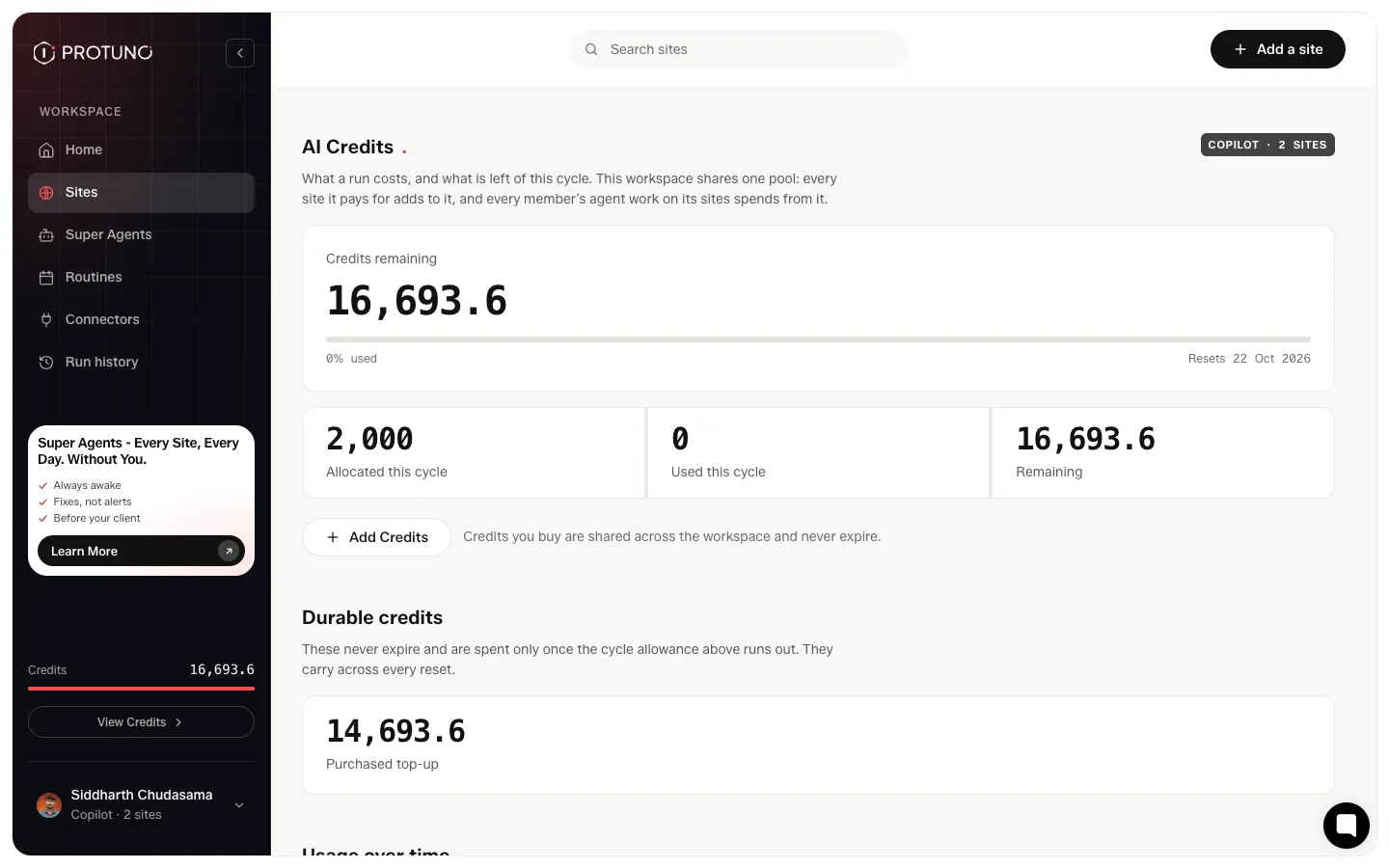
The balance sits on every screen rather than only in billing, which is deliberate. Discovering your usage at the end of the month is the thing this is designed to avoid.
Copilot and Autopilot compared
| Copilot | Autopilot | |
|---|---|---|
| Monthly, per site | $5 | $10 |
| Yearly, per site | $50 | $100 |
| Credits included, per site per month | 1,000 | 3,000 |
| Ready-made playbooks | All 17, plus your own | All 17, plus your own |
| Routines and calendars | No. You start every run | Yes |
| Platforms you can connect | 10 | All of them |
| Reports under your own name | No | Yes |
Every playbook is available on both plans. What changes is whether work can start without you, how many credits come with each site, how many platforms the workspace can connect, and whose name the reports go out under. Prices are before tax; Paddle adds what is due where you are.
Credits pool across the workspace. Ten Autopilot sites add 30,000 a month, and any site can spend any of it.
A site on neither plan cannot run playbooks. Its audits and monitoring still work and still cost nothing.
Team seats and Protuno Intelligence are on the plan cards as coming soon. Nothing is capped or withheld for them today.
Every playbook is available on both plans. What changes is how much happens before you are asked, and how many credits come with the plan. Prices are before tax; Paddle adds what is due where you are.
Buying credit packs
Credit packs are bought separately from the plan and do not expire with it. Packs you have bought stay on the account if you cancel; the monthly allowance that came with the plan does not.
Refunds
Refunds cover your first purchase, within 14 days, with no reason needed. What comes back depends on what has been spent since that payment:
- 3,000 credits or fewer used: full refund.
- More than 3,000 used: the value of everything used is deducted from what comes back. Not just the amount over the threshold. Above the line, all of it counts.
Unused credits come back with the refund. Credits an agent has already spent do not. Outside the 14 days, cancelling stops the next payment rather than returning the last one.
Refunds are approved by us and settled through Paddle, so they are not a button that issues itself. Ask from the cancel dialog on Billing, which hands support your workspace, plan, purchase date and credits used, or contact support directly. This matters most on Autopilot, where agents spend credits without being asked.
Cancelling, and what keeps running afterwards
From Billing, or from paddle.net. Cancelling stops future renewals. Your sites stay covered, and you keep that period’s credits, until the end of the period you have already paid for. Nothing is charged again.
It does not disconnect your sites and it does not stop your agents. Credits you bought in a pack stay on the workspace, and anything still switched on will keep running and keep spending them until the coverage ends. If you want the work to actually stop, switch the playbooks off, or disconnect the sites, or revoke the application passwords from your own WordPress profile. Cancelling alone does none of those.
Where to go next
- Run a playbook and read the report, to see where credits actually go.
- Routines, since a schedule is a recurring cost.
Comments