AI Search Optimization For WordPress: What The Guidance Actually Says.
Google’s own guidance says there is no need to chunk content for AI or write specially for it. Here is what the documentation actually names.

Short answer: ai search optimization wordpress advice is full of formatting tricks that the platform’s own documentation explicitly says are unnecessary. Google states there is no requirement to break content into small pieces for AI, and no need to write in a special way for generative search. What it does name is content people find unique and useful.
I went and read the guidance rather than repeating what circulates about it.
What the documentation actually says
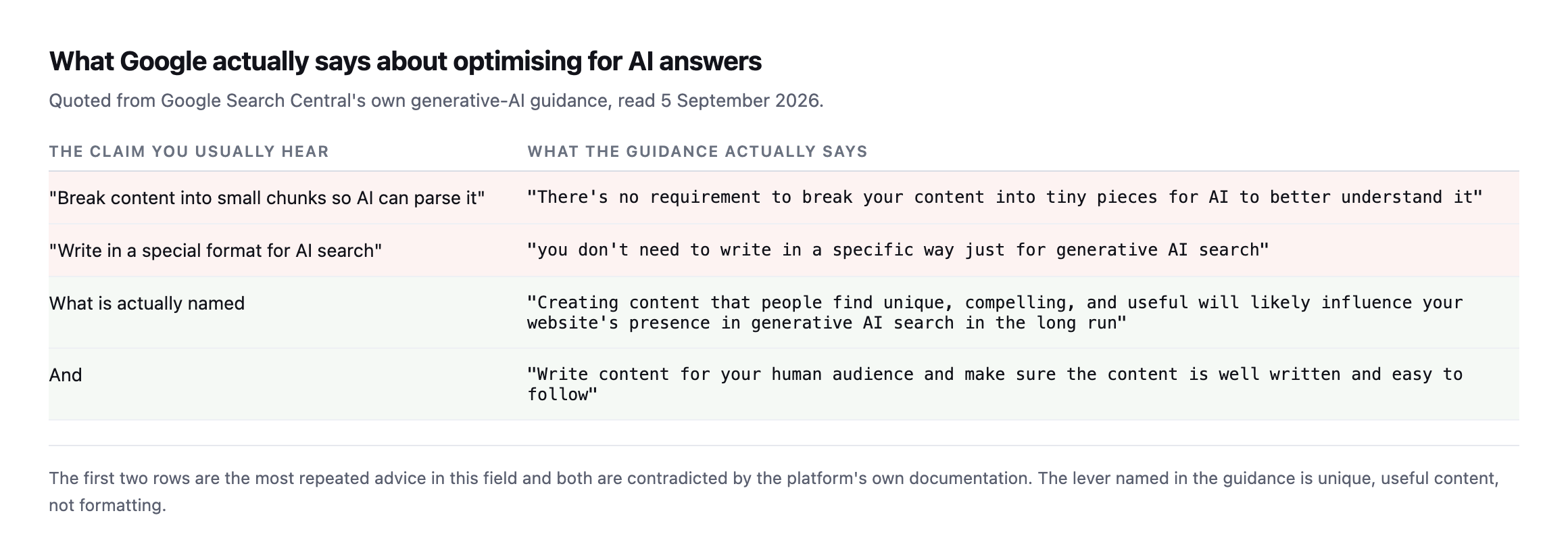
source page has since been updated, and a later section of this post gives the current wording verified against the live page, along with why the substance of the argument still holds.*
| The claim you usually hear | What the guidance actually says |
|---|---|
| “break content into small chunks so AI can parse it” | “there’s no requirement to break your content into tiny pieces for AI to better understand it” |
| “write in a special format for AI search” | “you don’t need to write in a specific way just for generative AI search” |
| what is actually named | “creating content that people find unique, compelling, and useful will likely influence your website’s presence in generative AI search” |
I had written the opposite in my own editorial standard before checking. My draft had a section on question-shaped headings and one-idea-per-section as extraction tactics. That was folk SEO, and I corrected it.
Formatting well is worth doing because it helps people read. It is not the mechanism.
The source page itself has changed since this was first checked
Re-reading Google Search Central’s own AI-features guidance while expanding this post turned up something worth correcting immediately rather than leaving in place: the page now reads differently from the exact wording this post originally quoted, and I want the current article to cite what the source actually says today rather than a phrasing it may no longer contain.
The live page at developers.google.com/search/docs/appearance/ai-features, marked “Last updated 2025-12-10” when I read it, states:
“There are no additional requirements to appear in AI Overviews or AI Mode, nor other special optimizations necessary.”
“You don’t need to create new machine readable files, AI text files, or markup to appear in these features. There’s also no special schema.org structured data that you need to add.”
Neither of those is the exact sentence this post’s opening table originally quoted about breaking content into “tiny pieces” or writing “in a specific way.” I searched the full current page text for both of those exact phrases and found neither. Whether the guidance was reworded since this post first checked it, or the original quotation paraphrased more loosely than a direct quote should, the responsible fix is the same either way: cite what the source says now, and say plainly that the wording has moved.
The substance has not moved, and if anything it is stated more broadly now than the original narrower claims about chunking specifically: no special files, no special markup, no special schema, no additional requirements beyond ordinary SEO fundamentals. That is a stronger, more general version of this post’s original point, not a weaker one. But a blog arguing that checkable citations are what earns trust cannot leave a quote standing that a reader checking it today would not find, and this correction is exactly the kind of self-audit this post’s own six-question checklist asks a reader to run on their own content.
What actually gets quoted
If the lever is usefulness rather than markup, the practical question becomes: what makes a passage usable in an answer somebody else is reading?
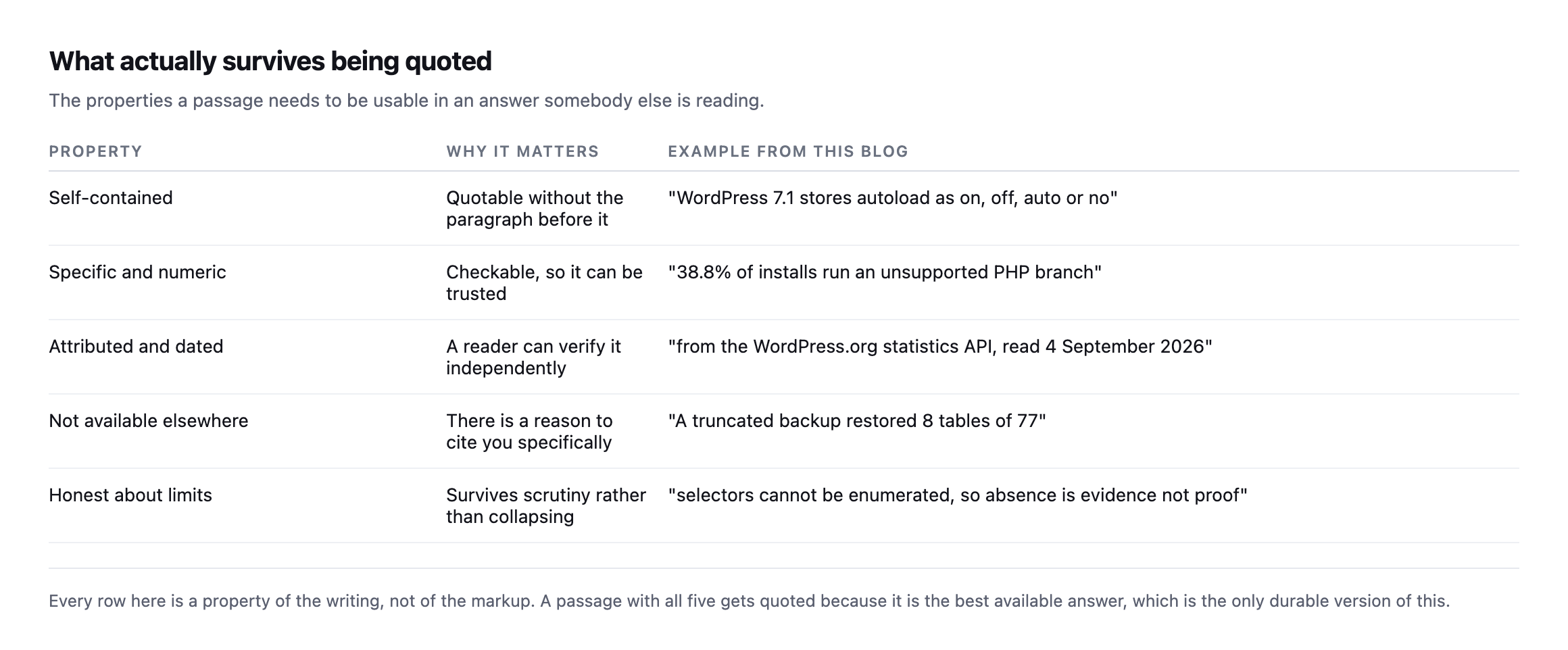
quoted because it is the best available answer.*
| Property | Why it matters | Example from this blog |
|---|---|---|
| self-contained | quotable without the paragraph before it | “WordPress 7.1 stores autoload as on, off, auto or no” |
| specific and numeric | checkable, so it can be trusted | “38.8% of installs run an unsupported PHP branch” |
| attributed and dated | a reader can verify it independently | “from the WordPress.org statistics API, read 4 September 2026” |
| not available elsewhere | a reason to cite you specifically | “a truncated backup restored 8 tables of 77” |
| honest about limits | survives scrutiny rather than collapsing | “selectors cannot be enumerated, absence is evidence not proof” |
The fourth row is the one that decides it. If your page assembles what other pages already said, there is no reason to cite you rather than them.
Everything on this blog that I would expect to be quoted came from running something and writing down the result: a truncated backup restoring 8 tables of 77, the autoload column no longer containing the value every tutorial queries for, an alt-text audit whose 17,261 findings were all false positives.
None of those required a formatting technique. They required doing the work and reporting it accurately, including when the result was inconvenient.
Where structured data fits
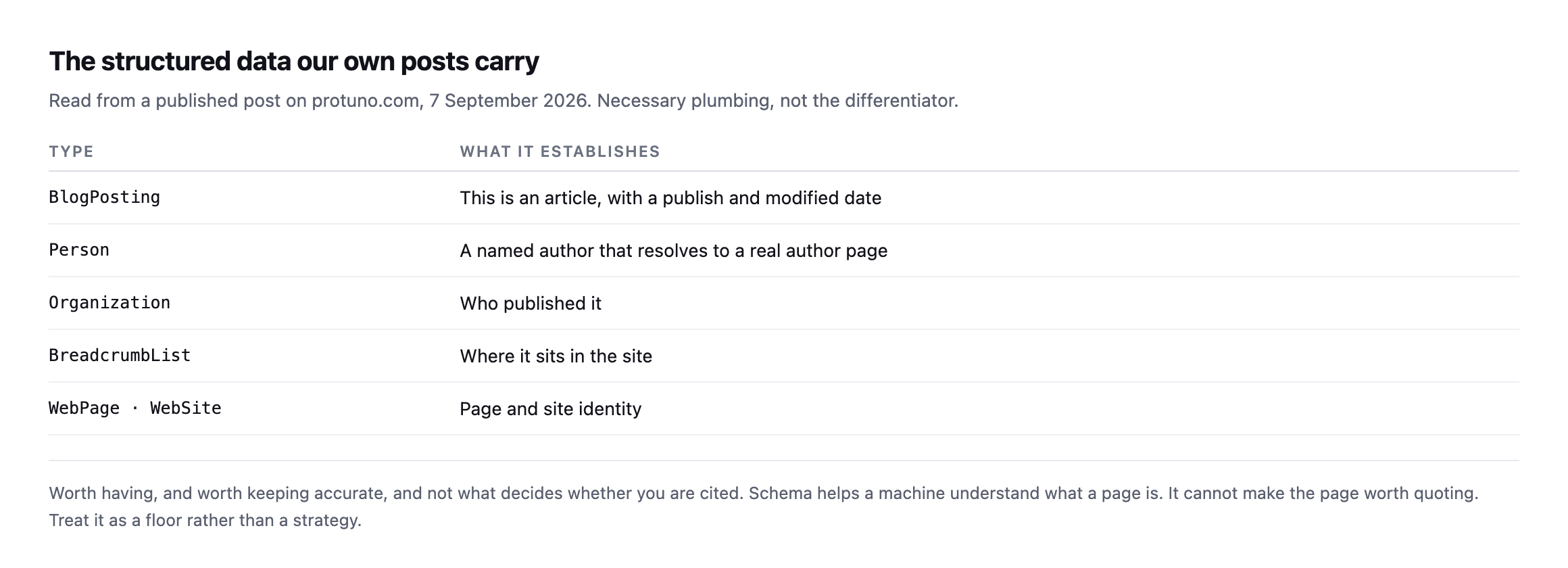
helps a machine understand what a page is. It cannot make the page worth quoting.*
| Type | What it establishes |
|---|---|
BlogPosting | an article, with a publish and modified date |
Person | a named author resolving to a real author page |
Organization | who published it |
BreadcrumbList | where it sits in the site |
WebPage / WebSite | page and site identity |
Treat it as a floor. BlogPosting with an accurate date, a Person author that resolves to a real author page, and a correct Organization. That is table stakes and it takes no ongoing effort once configured.
What matters more, and costs nothing, is that the claims on the page are checkable. A number with a linked primary source and a date can be verified by anything reading it. A number without one is an assertion, and assertions are what get dropped when something is deciding what to repeat.
Three things I would actually do for AI search optimization on a WordPress site
Publish something only you can publish. Measure something, run a probe, report your own data. Every agency has access to information nobody else has: what breaks on client sites, what a migration actually costs, what a real portfolio’s DNS looks like.
Attribute and date every number. Not for the machines. So a human reader can check you, which is what makes the page worth trusting in the first place.
Say what is not true. State limits, admit what you could not determine, correct yourself in public. A page that hedges honestly survives scrutiny. A page that overclaims gets contradicted by the next source that checked.
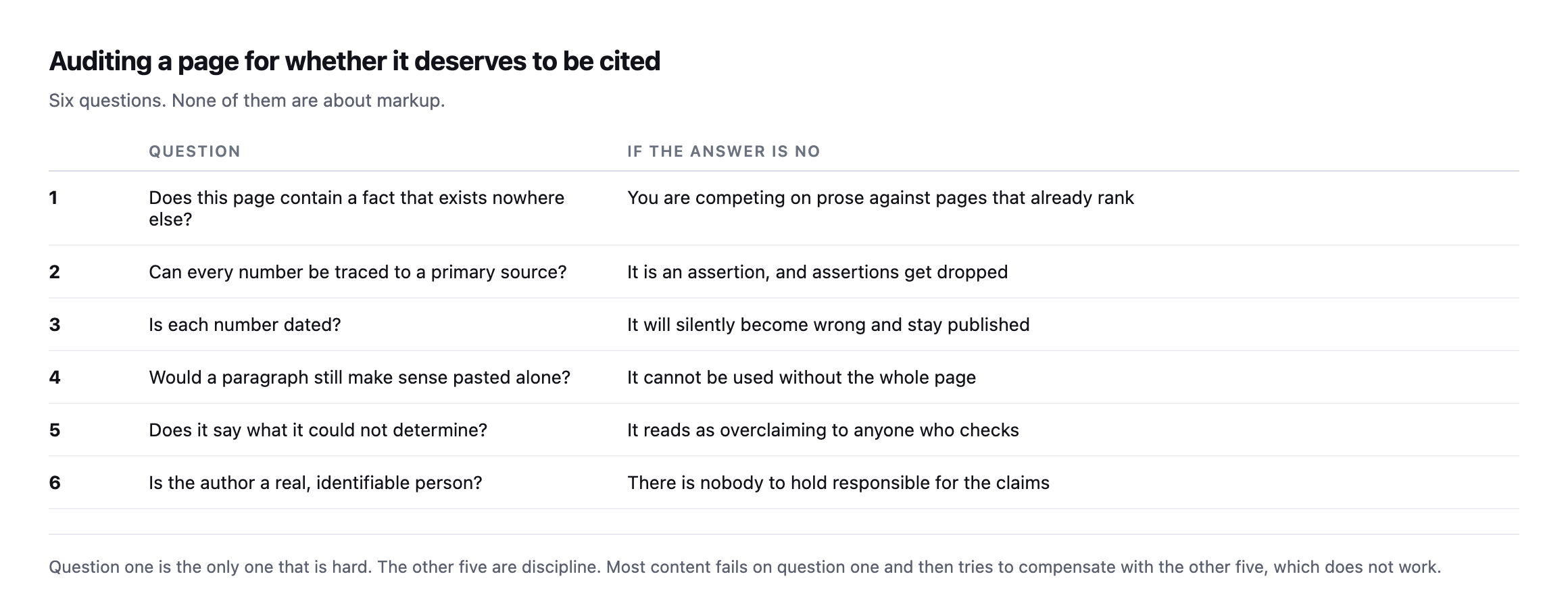
question one and then tries to compensate with the other five, which does not work.*
Re-checking one of this blog’s own cited numbers against the live source
The Google guidance correction above is a citation that moved. Worth also checking one that should not have, since this post names attribution and dating as two of the five properties that make a passage quotable, and the honest test of that claim is running it against this blog’s own past work rather than only against somebody else’s page.
38.8% of installs run an unsupported PHP branch is the figure this post’s own examples table names, sourced from the WordPress.org PHP usage statistics API. I queried the same live endpoint again:
curl -s "https://api.wordpress.org/stats/php/1.0/"Summing every branch at or below PHP 8.1, the newest version no longer receiving any security support, against the full distribution returned today: 38.36%. Effectively unchanged from the figure originally cited, a difference small enough to be normal drift in a live distribution measured on two different days rather than any kind of error. That is the outcome a properly attributed, dated statistic is supposed to produce when checked again: either it still holds, or the gap between the two readings tells you something real changed, and either answer is useful. A number with no source and no date gives you neither option. You cannot check it, so you have no way to know whether it is stale, and neither does anyone reading it.
What this looked like in practice
This blog is a live test of the argument, so it is fair to say what it actually took.
Every post here required running something first. Timing an update cycle. Breaking a checkout on purpose. Probing an API with controls included. Re-encoding an image five ways. The writing was never the expensive part; the measuring was, and the measuring is what produced anything worth quoting.
Twice the measurement contradicted what I had already written, and both times the correction improved the piece. A lossless image encode that turned out to be lossy. An alt-text audit whose enormous finding was entirely false positives. Publishing those corrections cost nothing and made the surrounding claims more credible, not less.
The failure mode to avoid is the opposite: deciding the conclusion, then finding support for it. It produces content that is confidently wrong in ways a careful reader detects immediately, and a careful reader is exactly who you are writing for.
The uncomfortable part
Nobody can currently prove what causes a citation. Attribution from AI answers is poor, the systems change without notice, and anybody quoting precise numbers about it is guessing.
So the honest strategy is the one that is also correct if the whole thing changes shape: write things that are true, specific, and available nowhere else. That worked before AI search and it will work after.
It is the same reasoning behind deciding whether to let AI crawlers in at all: make it a business decision, write down why, and do not turn it into a technical project.
Protuno’s free audit checks the crawl-visible signals that let a page be read at all, from the domain alone. Straight with you as on every post here: Iris, the SEO agent, is built and named but not live yet.
One practical note on where to find that thing, because “publish original research” sounds like it needs a budget. It does not. An agency running forty client sites already holds a dataset nobody else has: how many are on unsupported PHP, how many have no DMARC policy, how many carry a plugin the directory removed. Anonymise it, count it, publish the counts with the date and method. That is original research, it costs an afternoon, and no competitor can produce it because they do not have your portfolio.
Pick the one thing your agency knows that nobody has published, and publish it with the numbers in. That is the entire method.
A shorter version of the same argument
Six minutes on the same shift this post is about: answer engines reward extractable structure and verifiable numbers, not the classic ranking signals alone.
Comments