WordPress Cookie Consent: Which Scripts Fire Before Yes.
WordPress cookie consent can look right while scripts still fire first. Here is how to check, from outside, what loads before a visitor clicks yes.

A WordPress cookie banner has two buttons, Accept and Reject, and a line about cookies. That is the part everybody checks, because it is the part you can see.
What the banner does not show you is the page behind it. A banner can sit in front of a page that has already made its requests. On a site where a tag was added outside the consent plugin, the analytics tag, an ads pixel or a chat widget can fire before the banner has finished appearing.
Short answer: WordPress cookie consent has two halves. One is a banner that records a choice. The other is a loading order that decides what runs before that choice. To tell which half a site really has, load it in a fresh browser profile, click nothing, and write down every third-party request and every cookie that exists before the first click. Anything on that list that is not the consent tool itself or strictly functional fired before permission, whatever the banner says.
What this post is, and is not: this is a repeatable observation you can run from outside any site, in a browser, in about ten minutes. It is not legal advice, and it does not tell you whether a given script is lawful in your jurisdiction. It tells you what actually loaded. What that means for a given site is a conversation between the site owner and their counsel.
Why A Banner And Enforcement Are Different Things
A consent plugin usually does two separate jobs, and it is normal for a site to have only the first one working.
The first job is presentation: show a banner, record a choice, store it in a cookie, show a preferences link later. This part is visible, so it gets tested.
The second job is enforcement: actually prevent the tags from loading until the choice is made. This part is invisible, so it is rarely tested. It also depends on things the consent plugin does not control, including how each tag was added to the site in the first place.
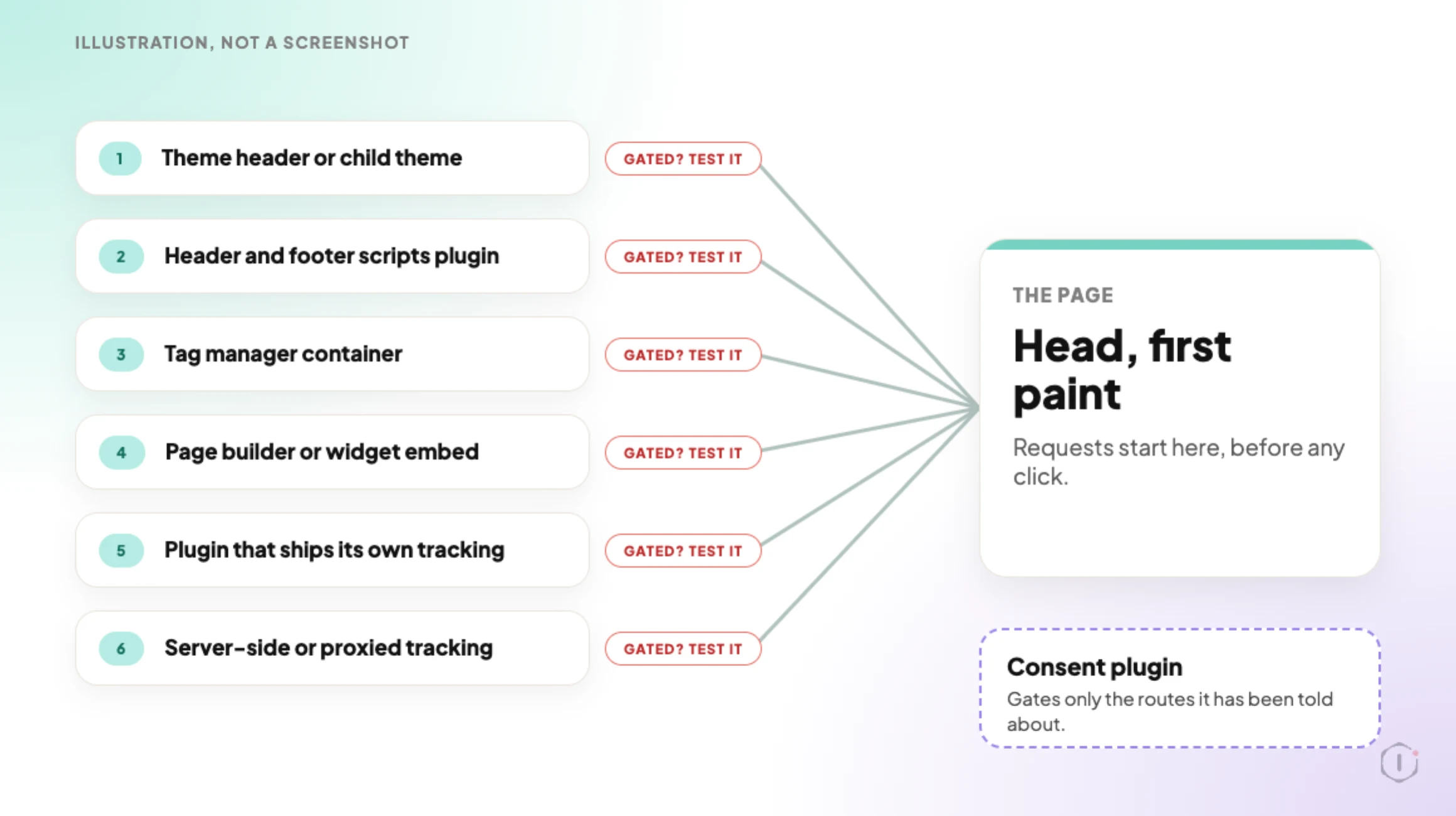
That is where the gap opens. A tag added through a tag manager container, a theme options field, a header-scripts plugin, a page builder widget or a hard-coded line in header.php is not automatically known to the consent plugin. The plugin can only block what it has been told to block, or what it can recognise.
So the honest version of the question is not “do we have a cookie banner”. It is:
Which scripts on this page run before a visitor has made a choice, and is that the intended list?
The Usual Sources Of A Pre-Consent Script
A pre-consent tag has usually arrived by one of a small number of routes. Knowing them shortens the hunt.
| Where the tag lives | Why consent often misses it | How you spot it |
|---|---|---|
| Hard-coded in the theme header or a child theme | It renders in wp_head before any consent logic runs | View source, search for the vendor domain, note it is not wrapped in a consent attribute |
| A header and footer scripts plugin | Output is a raw string the consent plugin cannot parse | Request fires on first paint with no consent cookie present |
| A tag manager container | The container loads, then fires its own tags on its own triggers | One container request followed by several vendor requests |
| A page builder or widget embed | Video, map and social embeds often set cookies themselves | Requests to an embed domain on pages that contain the embed only |
| A plugin that ships its own tracking | Analytics bundled into a forms, chat or reviews plugin | Request appears on every page, matched to a plugin asset path |
| Server-side or proxied tracking | Nothing third-party shows in the network panel at all | First-party request to an odd path, or no visible evidence from outside |
The last row is the honest limit of an external check, and it comes back later in this post.
The Ten Minute Check, Step By Step
This runs on any site you are authorised to test, from a browser, with no plugin installed and nothing changed. The panels are the Network and Application tabs in Chrome DevTools, and other browsers have the same two.
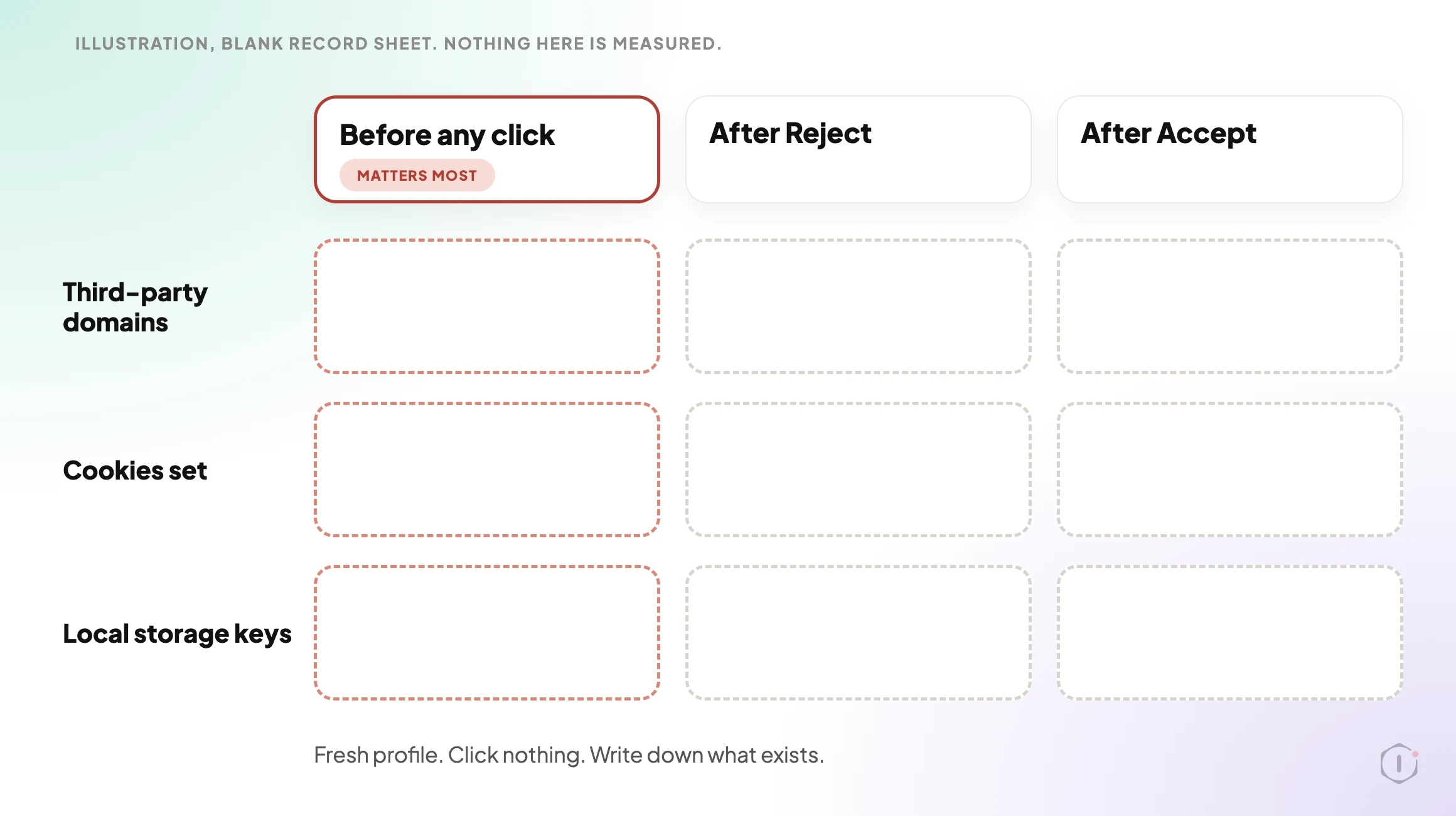
- Open a completely fresh private window. A fresh profile matters more than it sounds: an existing consent cookie makes the whole test meaningless, because the site will behave as though a choice was already made.
- Open the developer tools, go to the Network panel, and make sure request recording is on before you navigate.
- Load the page. A homepage first, then a post, then a page that has an embedded video or map, because those behave differently.
- Click nothing. Do not dismiss the banner.
- Sort the request list by domain. Write down every domain that is not the site’s own, and every domain that is the site’s own but is clearly a tracking path.
- Switch to the Application panel and list every cookie and every local storage key that now exists. Note which are first-party and which are third-party.
- Now click Reject. Reload. Repeat steps 5 and 6. Compare the two lists.
- Then click Accept in a new fresh profile and record a third list.
Three lists, one page. The one that matters most is the first one.
The useful output is not:
“The site has a cookie banner from a well-known consent plugin.”
It is:
“Before any click, this page set four cookies and made requests to three third-party domains. After Reject, it set two cookies and made requests to one. Here is which script is responsible for each.”
The numbers in that second line are an example of the shape of the answer, not a finding. A client can act on a statement like it, and a developer can fix it without guessing.
Reading The Result Without Overreading It
A request before consent is not automatically a violation, and this is where a lot of audits lose credibility by overclaiming. A font file, a CDN asset, a security challenge, or the consent platform’s own configuration request are different in kind from an advertising pixel. The cookie that stores the consent choice has to be set for the banner to work at all.
The categories worth separating:
- The consent mechanism itself. Its own script and its own choice cookie. Expected.
- Strictly functional. Session handling, cart state, security tokens, load balancing. Usually expected.
- Measurement. Analytics, heatmaps, session recording. This is the group where a pre-consent fire is usually unintended.
- Advertising and remarketing. Pixels, conversion tags, audience sync. This is the group where a pre-consent fire is usually the biggest problem.
- Embeds. Video players, maps, fonts loaded from a third party, social widgets. Often forgotten entirely, because the person who embedded the video was not thinking about tags.
Sorting your list into those five buckets takes a couple of minutes and changes the conversation from “you are non-compliant” to “these two things fire early, and here is where they come from”.
The flags on the cookies themselves are a separate question worth running in the same sitting: which flags WordPress core sets on its own cookies, and the one it leaves out covers the Secure, HttpOnly and SameSite side. This post is about whether the cookie should have existed yet at all.
The Tag Manager Case, Which Behaves Differently
A tag manager deserves its own paragraph because it fails in a way that looks like success. Install a consent plugin, point it at the container, and the container itself will often be correctly gated. You reload, see the container request held back, and conclude the job is done.
But a container can hold tags set to fire on triggers that never consult the consent signal, and tags someone added last quarter for a campaign that ended. The gate at the container level is only as good as the configuration inside it. Worse, a site can end up with the same measurement tag twice, once through the container and once hard-coded in the header by whoever set it up first. That is a counting problem as well as a consent problem, covered in duplicate Google Analytics tags.
If the numbers downstream also look wrong, the two are often one incident seen from different ends. Counting three sales from one order is the same class of fault: the page fires things nobody has a complete list of.
Can You Enforce This At The Header Level?
Partly, and it is worth knowing where the line is.
A content security policy restricts which origins a page may load resources from. That is a useful backstop: the browser blocks a script from an origin that is not on the allowlist, whichever plugin injected it. It gives you an enforced inventory rather than a hopeful one, and it makes an unexpected new third-party domain visible immediately instead of six months later. Getting one onto a WordPress site without taking the site down is its own exercise, written up in a WordPress content security policy that does not break the site, and the wider set of response headers is in two security headers you can set today.
What a policy will not do is express consent. It is static for all visitors, so it cannot say “allow this origin only after the visitor accepts measurement cookies”. Use the policy to control which origins are possible at all, the consent layer to control which of those fire before a choice, and the fresh-profile check above to verify the second one is working rather than merely installed.
What This Does Not Solve
This check is an outside observation of one browser, on a handful of pages, at one moment. It has real limits, and stating them is the difference between an audit and a guess.
- It cannot see server-side tracking. If measurement happens on the server, or is proxied through a first-party path, nothing distinguishable appears in the network panel. You can only find that by reading the code or asking.
- It is per page, not per site. A pixel added to one landing page will not show up unless you load that landing page. A site with hundreds of templates needs sampling.
- It is a point in time. A plugin update, a new embed, a caching or optimisation change, or a tag added for a campaign can reintroduce an early-firing script the week after you certified the site clean. WordPress 7.1.3 shipped on 6 October 2026 and 7.2 Beta 1 followed on 20 October. Neither announcement mentions cookies or consent, so nothing here depends on a core change.
- It does not read the consent record. Whether the choice is stored correctly, honoured on later visits, and available as evidence is a separate check against the consent platform.
- It says nothing about geography. Some consent setups behave differently by region. A clean result from one location does not describe the behaviour visitors elsewhere receive.
- It is not a legal conclusion. Loading a measurement script before a click is a fact. Whether that fact matters for a given site depends on jurisdiction, the nature of the data, and the legal basis claimed. This check produces the evidence, not the verdict.
A Portfolio Pass You Can Do This Week
If you run sites for other people, the single-site version of this is interesting and the portfolio version is useful.
Pick every site you are responsible for that has a consent banner. For each one, record four things in one row: whether any third-party request fires before a click, whether any non-consent cookie is set before a click, whether Reject actually reduces the list, and which route each early script arrived by.
If the sites cluster, that is the finding. One group built by the same person with the same header-scripts plugin will behave the same way, and a video embed on one page will show up only on that page. Clustering tells you whether you have thirty separate problems or two.
Then record the decision next to each row, not just the observation. Fix now, fix at the next release, accept with a named owner and a review date, or escalate because it is the client’s tag and their call. A row with a finding and no decision just moves the problem into a nicer spreadsheet.
Two Outside Views
A video that turns the same idea into a checklist. DataShyre’s “WordPress Cookie Consent in 2026: 7 Checks Before You Go Live“, published 14 August 2026, is a two-and-a-half-minute list of seven things to test before a consent setup goes live. Four of them match this post: test blocking on real templates and not just the homepage, look at what plugins do before consent, check that withdrawing consent really changes behaviour, and retest after updates to caching, plugins or optimisation. The video’s own line is that a banner is not enough and the setup needs an operational check. It is a short, small-channel video, so treat it as a reminder list, not a method.
Verify that withdrawing consent triggers real behavior changes across your site.
DataShyre, “WordPress Cookie Consent in 2026: 7 Checks Before You Go Live” on YouTube, 14 Aug 2026
A thread from people living with it. In an r/Wordpress thread titled “Videos do not appear unless allow cookies”, a site owner finds that embedded YouTube videos show as blank space until a visitor accepts cookies, and their cookie platform says that is standard behaviour. One reply points at the same embed problem from the other side:
There is a WP plugin No Cookies for YouTube which will make any video use YouTube’s no-cookie domain. That may help, but some cookie consent solutions will still treat YouTube’s alternative tracking methods (e.g. local storage) as needing consent just like cookies.
u/SpaceCmdr, r/Wordpress, 24 September 2026
That is the embeds row of the table in practice. The embed loads nothing until a choice is made, and what counts as loading depends on how the consent tool reads local storage, not only cookies. It is also why the Application panel step lists local storage keys next to cookies.
Sources And Further Reading
- Network features reference, Chrome DevTools, Chrome for Developers.
- View, add, edit, and delete cookies, Chrome DevTools, Chrome for Developers.
- Set up consent mode on websites, Google Tag Platform, Google for Developers.
- WordPress 7.1.3 Maintenance and Security Release, WordPress.org News, 6 October 2026.
- WordPress 7.2 Beta 1 is Ready for Download and Testing, WordPress.org News, 20 October 2026.
- WordPress Cookie Consent in 2026: 7 Checks Before You Go Live, DataShyre, YouTube, 14 August 2026.
- Videos do not appear unless allow cookies, r/Wordpress, 24 September 2026.
The Point
A banner is something visitors read. Enforcement is something the browser does, and only a network panel shows it.
So the question for your own portfolio is not whether the banners are installed, because they are. It is simpler and less comfortable: on how many of your sites has anyone actually loaded the page in a clean profile, clicked nothing, and read the list?
Comments